Overview & The Media Aggregation Challenge
Hasanuddin University's Community Service Program (KKN) deploys thousands of students whose activities are widely covered by various local and national media outlets. The core challenge for the university's publication team was tracking, collecting, and summarizing the thousands of news articles that had already been published online. Manually aggregating and recapping this massive volume of media coverage took days and was highly inefficient.
Multi-Channel Architecture & Cloudflare Workers
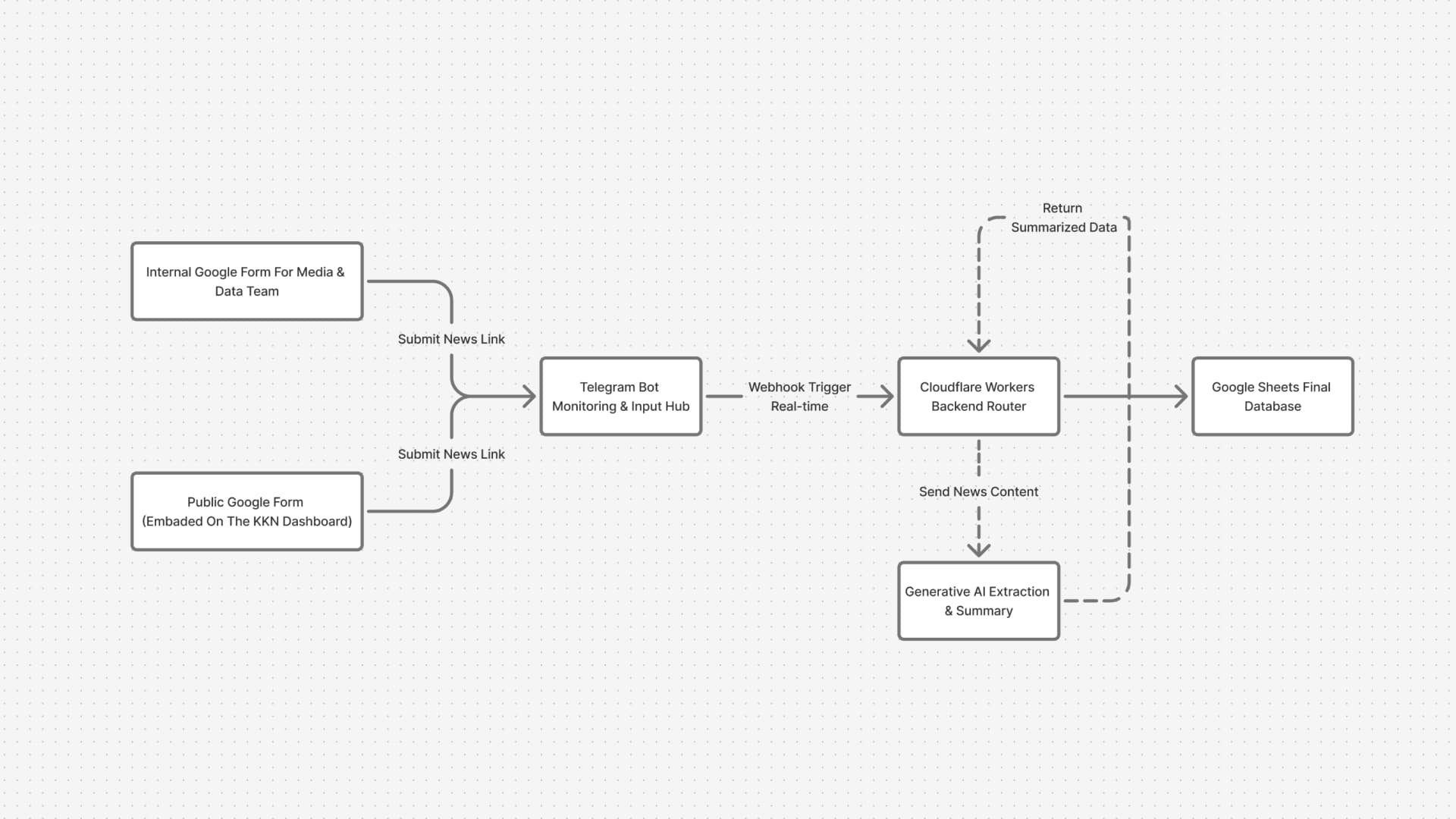
To resolve this bottleneck, I architected an automated recap pipeline with its backend hosted on Cloudflare Workers. The system supports three distinct input flows for submitted news links: a public Google Form on the KKN website for students, an internal Google Form for the Media & Data team, and a Telegram bot serving as both the processing hub and monitoring interface.
All news links submitted via Google Forms are instantly routed to Telegram, allowing the team to monitor incoming reports in real-time. The Cloudflare Workers backend, powered by AI, then processes the news content, extracts critical data points, and automatically logs the structured summary directly into Google Spreadsheets. This seamless pipeline reduced mass media processing time from several days to mere minutes.
Interface Showcase & System Workflow
To provide a clearer picture of the pipeline, here is a visual breakdown of the automation interfaces used by the team in real-time:
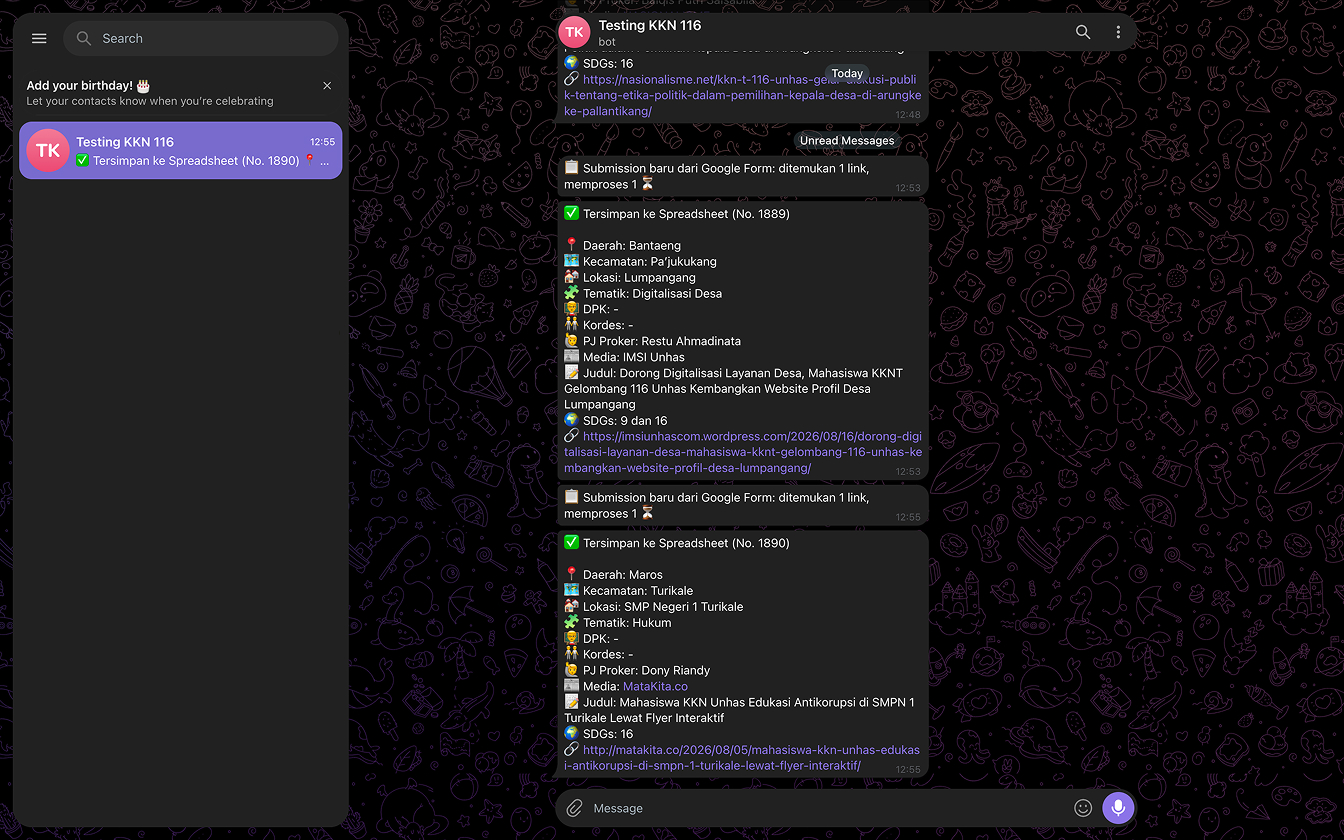
1. Rapid Input via Telegram: The internal team can submit news links directly through a Telegram chat. The system supports batch processing, allowing up to 10 links to be sent simultaneously. Once submitted, the bot instantly replies with the real-time processing status of each link.
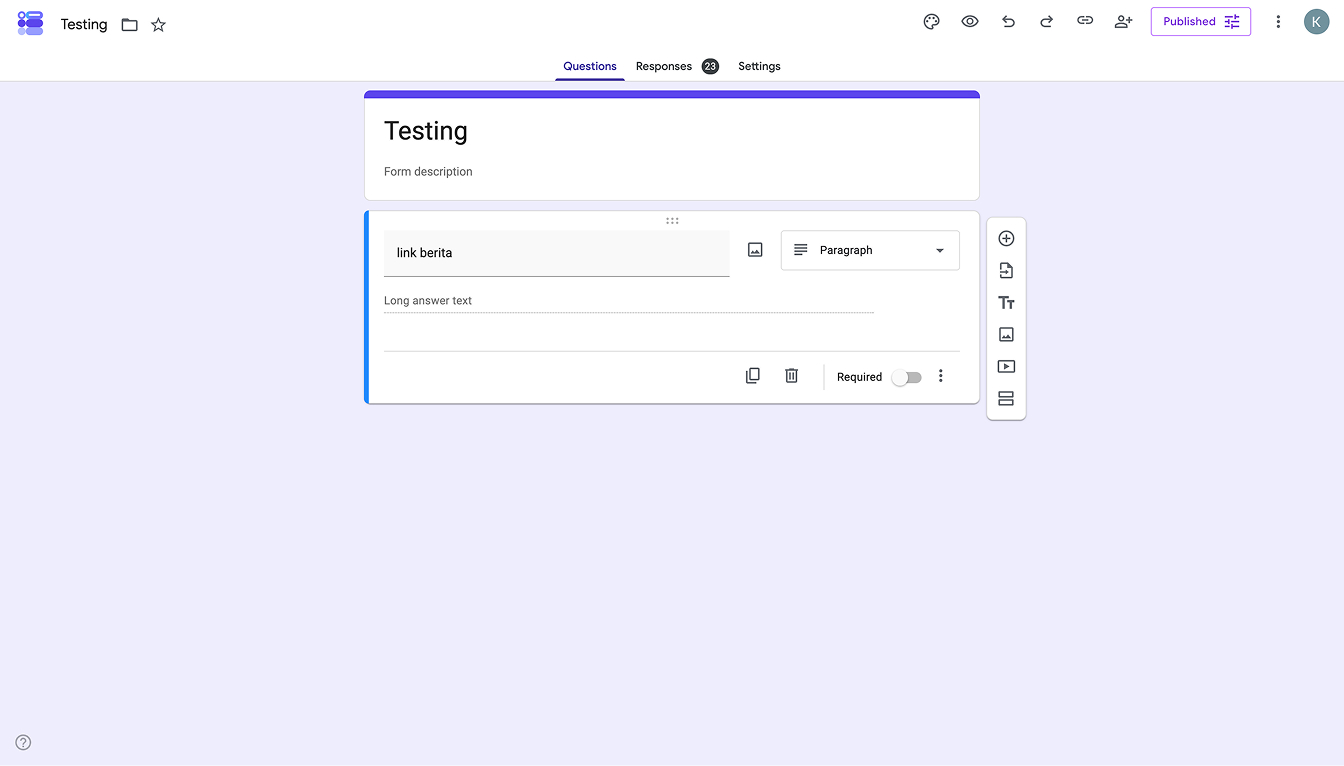
2. Google Form Alternative: Users can also submit links via a standard Google Form. The key feature here is that every form submission is automatically forwarded to the Telegram bot. This turns Telegram into a monitoring dashboard, allowing the team to oversee the data extraction process transparently.
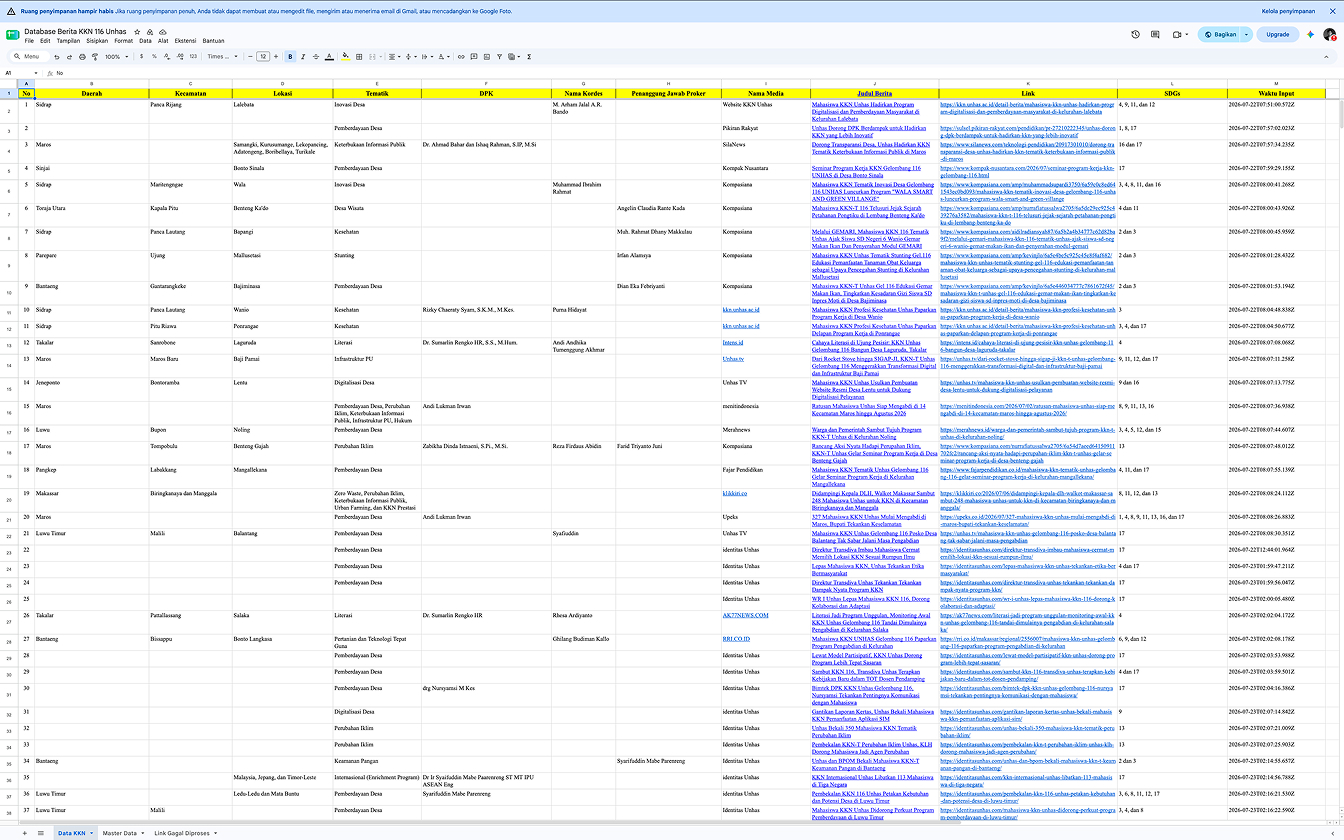
3. Structured Data Storage: If the AI successfully reads and extracts the information from the link, the system formats the data (names, locations, summaries, etc.) and seamlessly injects it into the primary "Data KKN" tab within Google Spreadsheets.
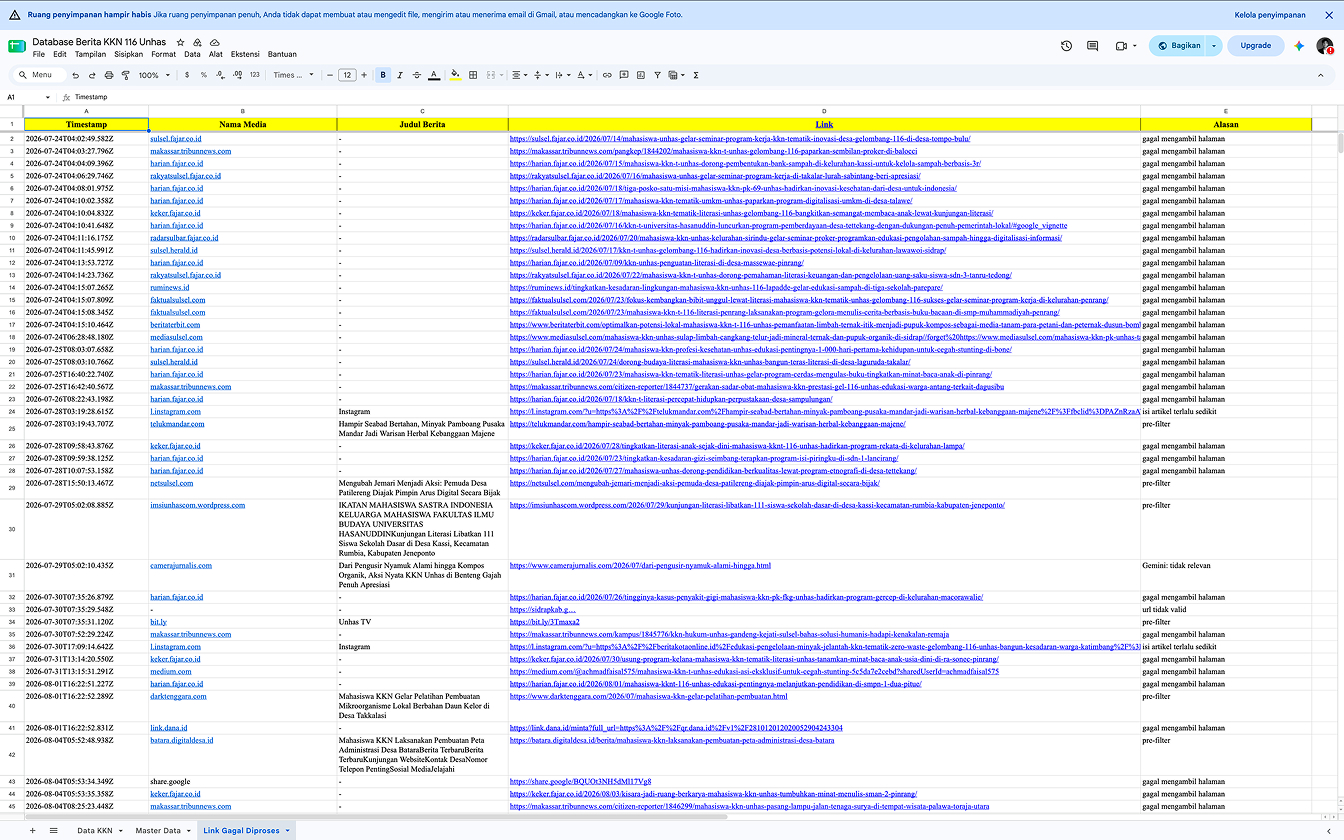
4. Error Handling Logic: Not all links can be processed perfectly. If an issue occurs, the system safely routes the link into a dedicated "Link Gagal Diproses" (Failed Links) tab, complete with the error reason. These failures typically stem from three variables: Gemini API rate limits, news portals utilizing anti-bot protections, or the article lacking any contextual mention of the keywords "KKN 116 Unhas".
Note: This automation system was developed exclusively for internal operational use by the Hasanuddin University publication team and is not publicly accessible.